Anti-Austerity Activist John Clarke: Fighting Back Against Cuts
Decades of organizing have taught John Clarke one lesson above all others: governments do not reverse harmful cuts out of conscience. They reverse them because people make it impossible not to.
John Clarke spent more than three decades as one of Canada’s most tenacious anti-austerity organizers. His work with the Ontario Coalition Against Poverty gave him a front-row view of how budget cuts translate into human suffering — and of what it actually takes to push governments back.
Clarke’s approach was never about polite lobbying or waiting for the next election cycle. It was about building enough disruption, enough visible public pressure, that reversal became more politically convenient than continuation. That approach drew criticism from some quarters and admiration from others, but it produced results in situations where more conventional advocacy had stalled.
His analysis of austerity, developed over decades of street-level organizing, offers lessons that apply far beyond Ontario — including to the budget battles that communities across Saskatchewan have faced and continue to face.
Who is John Clarke
John Clarke was the lead organizer of the Ontario Coalition Against Poverty (OCAP) from its founding in 1990 until his retirement from the organization in 2019. OCAP became known for its direct action tactics, confrontational public demonstrations, and its willingness to challenge government policy not only in the streets but through individual case advocacy on behalf of people navigating welfare, housing, and social service systems.
Clarke came to organizing through the labour movement and through direct exposure to the consequences of poverty in urban Ontario. Over time, he became a sought-after speaker and writer on austerity politics, publishing extensively on how structural adjustment policies developed by international financial institutions were adapted and applied by provincial and municipal governments across Canada.
Governments do not reverse harmful cuts out of conscience. They reverse them because people make it impossible not to — the political cost of continuing outweighs the political cost of retreat.
After leaving OCAP, Clarke continued writing and speaking on austerity, poverty, and public sector cuts, contributing analysis to outlets and coalitions across the country. His work remains a reference point for activists and organizers grappling with the recurring cycle of budget-driven service reductions.
The roots of austerity politics
Clarke has consistently argued that austerity is not primarily an economic necessity but a political choice — one that serves specific interests at the expense of others. The standard justification for cuts to public services, that governments must balance budgets the way households balance chequebooks, obscures the degree to which those choices are made deliberately and selectively.
Austerity, in Clarke’s analysis, tends to fall hardest on the programs and services that lower-income people depend on most: social housing, welfare rates, legal aid, public transit, libraries, and community health centres. Programs that primarily benefit wealthier residents — including tax expenditures, corporate incentives, and infrastructure that serves business districts — tend to survive budget crunches with less scrutiny.
This pattern is not accidental. It reflects the distribution of political power. People who rely on social housing do not typically have the same capacity to lobby government, fund legal challenges, or generate sympathetic media coverage as those whose interests align with corporate tax policy. Austerity, in this sense, is the budget expression of who has power and who does not.
How cuts actually land on communities
One of Clarke’s most valuable contributions to public debate has been insisting on naming the concrete consequences of cuts rather than accepting the abstract fiscal language that typically surrounds budget announcements. When a government announces a reduction in social service funding, what that means in practice is that a specific number of people lose access to a specific kind of help, with specific consequences for their housing, health, and basic stability.
The people absorbing those consequences are rarely visible in budget debates. They do not hold press conferences. Their situations are not easily reduced to a soundbite. Austerity politics depends on this invisibility: as long as the human cost of cuts remains abstract, it is easier to present them as a neutral fiscal adjustment rather than a decision that harms real people.
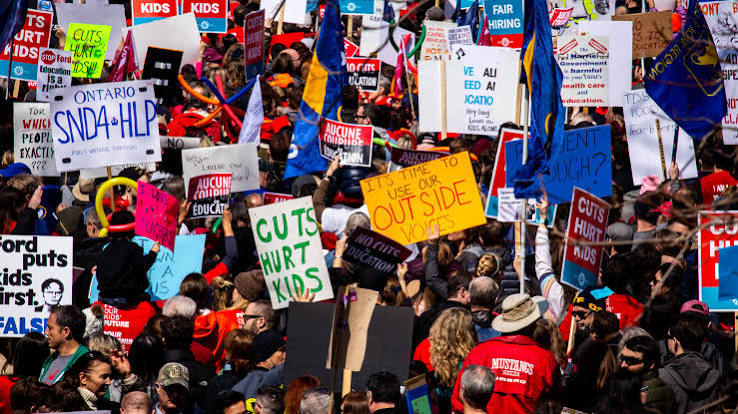
Clarke’s organizing work deliberately broke that abstraction. OCAP brought the people most affected by cuts directly into public view, making it harder for government officials to discuss welfare reductions or housing cuts without confronting the actual consequences of those decisions.
The tactics that work
Clarke has always been candid about the limits of conventional advocacy. Letter-writing campaigns, delegations to ministers, and media releases have their place, but they are rarely sufficient on their own to reverse decisions that a government has already committed to. Governments under fiscal pressure are under pressure to cut; the question is whether they face more pressure to reverse those cuts than to continue them.
Building that counter-pressure requires visibility, persistence, and a willingness to cause disruption that is uncomfortable to ignore. It also requires solidarity across different affected groups. A campaign to protect library funding is stronger if it connects with a campaign to protect transit, legal aid, and community health services — because those campaigns draw on overlapping communities and face the same underlying political logic.
Coalitions like SaskForward exist precisely to build that kind of solidarity, connecting organizations working on different issues under the same broad framework of opposition to austerity. Clarke’s analysis of what makes resistance effective aligns closely with the coalition model: broad participation, clear shared framing, and a willingness to sustain pressure beyond any single budget cycle.
Saskatchewan and the national picture
The dynamics Clarke describes in Ontario are not unique to that province. Saskatchewan’s 2017 budget fight over library funding, which forced a partial reversal through public pressure, followed the same basic pattern: a government made cuts that it judged would not generate sufficient backlash, and then discovered it had miscalculated the depth of public attachment to those services.
That reversal was a victory, but Clarke’s analysis would caution against treating it as a durable settlement. Governments that reverse cuts under pressure do not necessarily change the underlying priorities that led to the cuts in the first place. They wait for pressure to subside, and then return to the same agenda under different conditions, different framing, or a different budget year.
Sustained protection for services like public libraries, community health programming, or rural transit requires more than winning individual budget fights. It requires changing the terms on which those services are understood by the public and by decision-makers — from discretionary amenities that can be trimmed when revenue tightens, to core public infrastructure that reflects a community’s fundamental commitments.
What sustained resistance looks like
Clarke has argued that effective anti-austerity organizing cannot be purely reactive. A movement that only mobilizes when cuts are announced is always playing catch-up, fighting to recover ground that has already been lost rather than building the conditions under which those cuts are less likely to be attempted in the first place.
Sustained resistance means maintaining coalitions between budget cycles, not just activating them in crisis. It means doing the slower work of building public understanding of why certain services matter, so that when a budget threat arrives, the case does not have to be built from scratch under time pressure. And it means holding governments accountable not just for the cuts they announce, but for the chronic underfunding that erodes services more quietly over years.
John Clarke’s decades of organizing offer a clear-eyed map of both the obstacles and the possibilities in that work. The obstacles are real: governments have significant power to manage public information, to time announcements strategically, and to wait out short-term mobilizations. But the possibilities are real too. Communities that understand what they are fighting for, and that build the organizational capacity to fight over time, have forced reversals that once seemed impossible.
Who is John Clarke and why does his work matter?
John Clarke is a long-time Canadian anti-poverty and anti-austerity organizer, best known for leading the Ontario Coalition Against Poverty for nearly three decades. His analysis of how cuts are made and how communities can effectively resist them offers practical lessons for activists across the country.
Is austerity an economic necessity or a political choice?
Clarke argues consistently that austerity is a political choice, not an economic inevitability. Budget cuts tend to target services that lower-income people rely on most, while leaving intact programs that benefit more politically powerful interests — a pattern that reflects power rather than fiscal logic.
Why do conventional advocacy methods sometimes fall short?
Letter-writing and delegations have their place, but they are rarely sufficient to reverse decisions a government has already committed to. Effective resistance usually requires building enough visible public pressure that continuing with cuts becomes more politically costly than reversing them.
How does Saskatchewan’s experience connect to Clarke’s broader analysis?
The 2017 Saskatchewan library funding fight followed the same pattern Clarke describes: a government underestimated public attachment to a service, faced intense organized opposition, and partially reversed its decision. Clarke’s analysis would caution that such reversals are not permanent without sustained pressure and coalition-building between budget cycles.
What does sustained anti-austerity organizing require?
It requires maintaining coalitions and public education between budget crises, not just mobilizing reactively when cuts are announced. Building shared public understanding of why services matter makes it harder for governments to cut them and easier to win reversals when cuts are attempted.
Similar Posts
Progressive Taxation A Fairer Path for Saskatchewan’s Revenue
Budget & Economic Justice 26 August 2026 11 Comments Progressive Taxation Rebuilding a genuinely progressive tax system is one of the clearest ways Saskatchewan could fund public services without repeating past austerity. On This Page How Saskatchewan’s system compares What the 2017 consultation asked for The corporate side of the equation What progressive revenue could…
Corporate Tax Breaks vs. Public Investment Rethinking Saskatchewan’s Priorities
Budget & Economic Justice 26 August 2026 9 Comments Corporate Tax Breaks vs. Public Investment Every budget is a statement of priorities disguised as a spreadsheet. Protecting corporate tax advantages while cutting services is a choice, not a fiscal law of nature. On This Page What corporate competitiveness means What public investment returns The 2017…
Understanding Saskatchewan’s 2017 Budget Who Really Paid the Price
Budget & Economic Justice 26 August 2026 18 Comments Understanding Saskatchewan’s 2017 Budget: Who Really Paid the Price A closer look at where the cuts landed, who was protected, and why the choices made in 2017 still shape provincial budgeting today. On This Page A budget built on cuts, not conversation Who felt the cuts…
The Hidden Cost of Austerity How Budget Cuts Ripple Through Communities
Budget & Economic Justice 26 August 2026 22 Comments The Hidden Cost of Austerity A budget cut rarely stays contained to the line item it was written on. It travels outward through households, workplaces, and entire communities. On This Page The first wave: direct cuts The second wave: downloaded costs The third wave: strain on…