Why Coalitions Work
SaskForward formed as a broad coalition, not a single-issue campaign. That structure was not incidental. It was the strategy.
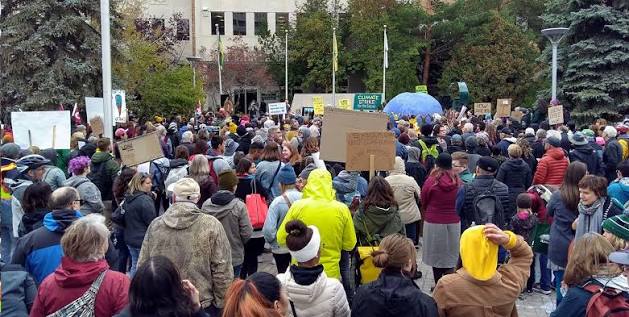
SaskForward was never built around a single organization or a single issue. It formed as a broad coalition, bringing together groups working on climate, poverty, health, housing, and civil liberties under a shared response to Saskatchewan’s 2017 budget. That structure was not incidental. It was the strategy.
Single-issue organizations, no matter how effective, face a structural limitation when they act alone: a government can dismiss a narrow constituency’s concerns as a special interest, and can wait out a single issue’s news cycle. A coalition spanning dozens of organizations and thousands of individual supporters is much harder to dismiss, and much harder to outlast.
Strength in breadth
SaskForward’s list of partners reads like a cross-section of Saskatchewan civil society: the Canadian Centre for Policy Alternatives, Climate Justice Saskatoon, the Saskatchewan Health Coalition, Poverty Free Saskatchewan, the Council of Canadians chapters in Saskatoon and Prince Albert, Renters of Saskatoon and Area, and many more. Each organization brought its own specific expertise and its own specific constituency, but all shared a common concern about the direction of the 2017 budget.
That breadth mattered strategically. When library advocates, health care organizers, anti-poverty groups, environmental organizations, and tenant advocates all point to the same budget and raise related but distinct concerns, it becomes much harder for a government to frame the opposition as a narrow, unrepresentative faction. It starts to look like what it actually is: a broad cross-section of the public raising a shared concern.
Shared infrastructure, distinct expertise
A coalition model allows organizations to share the practical burden of large-scale organizing, from running a province-wide consultation process to coordinating public communications, while still allowing each partner organization to bring its specific expertise to bear on the issues it knows best.
The Saskatchewan Health Coalition understands health policy in detail that a general anti-austerity campaign might miss. Renters of Saskatoon and Area understands the specific dynamics of the rental market. Climate Justice Saskatoon understands environmental policy and its intersection with economic justice. A coalition structure allows these forms of specialized knowledge to inform a shared, unified message, rather than requiring every organization to develop expertise across every issue independently.
SaskForward is a broad coalition of civil society organizations and individuals. We believe that there are solutions for creating a prosperous, sustainable, and just future for all.
The consultation as a coalition-building tool
SaskForward’s 2017 province-wide consultation served a dual purpose. It gathered public input on what transformational change residents actually wanted to see, and it also served as an organizing tool, engaging thousands of Saskatchewan residents directly in a process that made them stakeholders in the coalition’s subsequent advocacy work.
This kind of direct public engagement distinguishes a genuine grassroots coalition from a purely advocacy-driven campaign run by a small group of organizational staff. When people have been asked directly for their input, and have seen that input reflected in a coalition’s subsequent public messaging, they are more likely to stay engaged, to share the coalition’s work within their own networks, and to participate in future organizing efforts.
Coalitions and the challenge of staying unified
Coalition work is not without its internal tensions. Organizations with different institutional priorities, different levels of organizational capacity, and sometimes different political strategies have to find enough common ground to act together effectively, without any single partner feeling that its specific priorities have been submerged entirely within the coalition’s broader message.
SaskForward’s approach of centring a shared consultation process, built around an open-ended question rather than a predetermined policy platform, offered a way to build genuine consensus from the ground up rather than asking partner organizations to simply endorse a position developed elsewhere. This kind of process takes longer to build than issuing a pre-written statement, but it produces a foundation that is considerably more durable.
What sustained coalition work requires
A coalition’s effectiveness in a single budget cycle, however significant, is not the same as its long-term durability. Sustaining a coalition across multiple years and multiple budget cycles requires ongoing communication between partner organizations, a shared understanding of the coalition’s evolving priorities, and enough organizational trust that partners are willing to continue coordinating even when a specific campaign has ended and there is no immediate crisis driving urgency.
SaskForward’s continued existence years after the 2017 budget fight reflects that kind of sustained investment in coalition infrastructure, treating the relationships between partner organizations as an asset worth maintaining, not simply a temporary alliance convened for a single fight and then allowed to dissolve.
A model for future organizing
The core lesson from SaskForward’s coalition model is straightforward but not always easy to apply: broad, sustained coalitions built on genuine public consultation are more resilient, more representative, and ultimately more effective than narrow, single-issue campaigns operating in isolation from one another.
As Saskatchewan faces future budget cycles, future policy debates, and future moments where public services and economic fairness are put on the table for negotiation, the coalition model that SaskForward built in 2016 and 2017 remains a template worth understanding, adapting, and building on for whatever the next fight turns out to be.
Why did SaskForward form as a coalition rather than a single organization?
A broad coalition is harder for a government to dismiss as a narrow special interest. When many organizations with different constituencies raise related concerns, it reflects a genuine cross-section of public opinion rather than one group’s agenda.
How do coalition partners divide their work?
Each partner organization brings its own specialized expertise, whether in health policy, tenant rights, or climate justice, while sharing the broader organizing infrastructure, such as consultations and public communications.
What role did the 2017 consultation play in coalition-building?
The consultation gathered public input while also engaging thousands of residents directly, turning them into stakeholders in the coalition’s advocacy rather than passive observers of a campaign run by staff alone.
How do coalitions manage internal disagreements?
Building consensus through an open-ended consultation process, rather than asking partners to simply endorse a predetermined position, helps coalitions find genuine common ground without submerging any one partner’s priorities.
Why has SaskForward continued to exist years after 2017?
Sustaining a coalition requires ongoing communication and trust between partner organizations, treating those relationships as a long-term asset rather than a temporary alliance for a single campaign.